Discounts Don’t Scale. Systems Do

In today’s competitive distribution landscape, many companies rely heavily on trade promotions to drive sales. Yet, despite well-planned strategies, results often fall short. The problem isn’t the idea; it’s the execution.

Across industries, trade promotions are still managed through fragmented processes:
This lack of structure leads to inefficiencies, and globally, businesses lose 15–25% of their trade promotion budgets due to poor tracking and execution gaps.

The Core Problem: Lack of System-Driven Execution

Trade promotions involve multiple stakeholders: dealers, distributors, influencers, and internal teams. Without a centralized system, data gets scattered, decisions get delayed, and performance becomes difficult to measure.

This is where software-driven transformation becomes essential.

A well-designed Dealer Management System (DMS) doesn’t just record transactions, it creates a structured, scalable framework for managing promotions and driving growth.

How a Modern DMS Transforms Trade Promotions

With the right IT architecture in place, businesses can move from manual chaos to intelligent automation. A robust DMS enables:
This ensures that every promotion is not only executed efficiently but also tracked and optimized continuously.

From Guesswork to Data-Driven Decisions

When promotions are system-driven, leadership gains complete visibility into performance. Instead of relying on assumptions, decision-makers can clearly see:
This level of insight turns trade promotions into a strategic growth lever, rather than a cost center.

Building a Connected Growth Ecosystem

The real power of a DMS lies in integration. When trade promotions, loyalty programs, and influencer ecosystems are unified within a single platform, businesses unlock:

This is the shift from isolated tools to a connected digital ecosystem—designed for efficiency, visibility, and long-term growth.

The Role of Software Development in Channel Transformation

As a software development partner, the goal goes beyond building features. It’s about designing structured IT systems that align technology with business outcomes.

By developing customized DMS platforms, companies can:
In essence, software transforms dealer networks into high-performing growth engines.

Conclusion

Discounts alone cannot drive sustainable growth. Without the right systems, even the best strategies fail to deliver results. But with a purpose-built Dealer Management System, businesses can bring structure, visibility, and scalability to their trade promotions.

Because in the end, growth isn’t a scheme; it’s a system.

Why 60% of Buying Decisions Happen Outside Your System, & How to Capture Them

In industries such as automotive, building materials, electricals, and consumer durables, buying decisions are rarely made in isolation. While companies invest heavily in dealer networks and distribution channels, a significant portion of influence lies beyond their direct visibility.

Contractors, mechanics, architects, and installers often play a decisive role in shaping customer choices. Industry studies indicate that 50–70% of trade purchases are influenced by these on-ground advisors. Yet, despite their impact, most organizations fail to formally track, engage, or reward them.

This gap leads to lost visibility, missed opportunities, and ultimately, lost revenue.

The Hidden Layer of the Demand Chain

Traditional systems focus on dealers and transactions, the billing layer. But the real demand chain is much broader. It includes:
Ignoring this layer means businesses only see part of the picture.

The Evolution: From Dealer Management to Ecosystem Management

A modern Dealer Management System (DMS) should go beyond managing dealers. It should function as a complete digital ecosystem that captures every stakeholder influencing a sale.

With the right IT framework, businesses can:
This transforms a fragmented network into a connected, data-driven ecosystem.

The Business Impact of Influencer Integration

Organizations that digitally integrate influencer programs into their systems often experience:
This is not just about offering incentives; it’s about building visibility into the entire decision-making journey.

Why It Matters More Than Ever

In today’s competitive landscape, relying solely on dealer data is no longer sufficient. Businesses need to understand:
Capturing this intelligence allows companies to engineer growth instead of leaving it to chance.

The Future: Engineered Growth Through Digital Ecosystems

Forward-thinking organizations are shifting from “dealer management” to “ecosystem management.” By embedding influencer tracking and engagement into their DMS, they gain:
When the entire ecosystem is structured within your system, growth is no longer accidental; it becomes predictable, measurable, and engineered.

Conclusion

Most buying decisions are influenced outside your dealer network. By integrating influencers into your Dealer Management System (DMS), you gain visibility, improve engagement, and drive predictable growth, turning your sales process into a complete, data-driven ecosystem.

Dealer loyalty built only on relationships creates inconsistency and chaos.

Dealer loyalty powered by structured systems, scales, and drives predictable repeat orders, while if it is solely built on relationships, can create inconsistency and chaos.

Most companies believe dealer loyalty is built on:
But here’s what we’ve seen repeatedly:

If loyalty is not system-driven, it doesn’t scale.

Channel data across industries shows:
Yet many organizations still run loyalty programs on:

Excel sheets.
Manual claim approvals.
Delayed reward calculations.

That’s not loyalty. That’s administrative chaos.

A purpose-built Dealer Management System changes this.

When IT architecture supports loyalty, you enable:
Now dealers don’t wait for quarterly reconciliation.

They see progress in real time.

As an IT partner, our role isn’t to digitize schemes.

It’s to build a structured loyalty engine inside your DMS that drives predictable growth.

The Real Problem is Not Strategy. It’s System Design.

Most dealer ecosystems fail not because of poor intent, but because of:
As an IT partner, our role isn’t just to digitize schemes.

It’s to architect a scalable loyalty engine—built on data pipelines, rule engines, and real-time systems—that drives predictable, repeatable growth.

Look out for our next blog post where we discuss the most ignore growth lever inside dealer ecosystems

Insights from 18 Months of Driving Digital Transformation in an Automotive OEM

For the past 18 months, we’ve been closely involved in digitising operations for an automotive rubber components manufacturer.

On paper, it sounded straightforward: Build an internal E-Catalogue. Launch a Dealer Management System. Improve efficiency.

In reality, it turned into a much deeper operational shift than any of us initially anticipated.

Here’s what we personally learned.

1. The Problem Wasn’t Software — It Was Visibility

Before we wrote a single line of code, we discovered something uncomfortable.

Different teams were working with different versions of product information. Sales had one sheet. Operations had another. Management had summaries.

The real issue wasn’t a lack of technology. It was a lack of alignment.

The E-Catalogue forced us to standardise how products were structured, described and accessed. That discipline alone created more impact than the UI ever did.

2. SKU Complexity Is Easy to Ignore Until You Try to Structure It

Automotive components sound simple until you map:
Designing filtering logic made us realise how messy the underlying classification had become over time.

Reducing product search time by 40% wasn’t about speed; it was about forcing clarity.

3. Dealers Don’t Want Phone Calls — They Want Control

When we began designing the Dealer Management System, we assumed ordering was the main pain point.

It wasn’t.

Dealers wanted:
The self-service portal changed the tone of the relationship. Engagement increased by 25%, but more importantly, trust improved.

4. Automation Is Only Helpful If It Removes Friction

We automated order closure after 75 days.

Simple rule. Big impact.

But getting there required debate: What if someone forgets? What if dispatch delays happen? What if pricing disputes exist?

Every “small automation” forces operational decisions.

Technology surfaces process ambiguity. It doesn’t hide it.

5. Pricing Logic Is Emotional, Not Just Mathematical

Introducing custom rate cards based on dealer turnover was powerful.

But it required careful communication.

Dealers compare. They talk. They calculate.

The system could manage dynamic pricing, but alignment conversations were human.

6. Adoption Was the Real Project

The tech stack (Django, PostgreSQL, mobile interface) was structured and reliable.

What took longer:
Some team members quietly reverted to old habits in the early weeks. That’s when I realised digital transformation is behaviour change.

7. Metrics Build Confidence

When we saw:
The organisation stopped asking, “Why did we do this?” Numbers remove doubt.

8. Software Exposes What Was Hidden

The most uncomfortable lesson? Systems reveal inefficiencies. Duplicate SKUs. Inconsistent pricing. Manual overrides. Untracked orders. None of this was visible before digitisation. The platform didn’t create problems. It illuminated them.

9. Transformation Is Ongoing

We’re now discussing:
But the real shift has already happened. The company now thinks digitally.

Final Reflection

This wasn’t an IT upgrade. It was a clarity exercise.
Digitising an automotive OEM taught me that:
Technology is rarely the bottleneck. Structure, discipline, and alignment usually are. If you’re about to start a similar journey, expect fewer technical problems and more organisational conversations. And that’s not a bad thing.

AI Chatbot Customer Support

AI Chatbot Customer Support: SplendorNet's Revolution in Customer Service

In today’s fast-paced digital environment, customers expect personalized interactions, prompt responses, and support that is accessible anytime, from anywhere. To meet these growing demands, businesses are rapidly adopting AI-powered chatbot customer support solutions.

At SplendorNet Technologies Pvt Ltd, we help businesses leverage AI-powered chatbots to enhance customer service, boost productivity, and deliver exceptional user experiences.

What Is an AI Chatbot?

An AI chatbot is an advanced virtual assistant that uses artificial intelligence (AI) and natural language processing (NLP) to understand customer queries and deliver human-like responses. Unlike traditional rule-based systems, AI chatbots continuously learn and improve their accuracy over time.

SplendorNet designs and deploys AI chatbots that seamlessly operate across websites, mobile applications, and popular messaging platforms.

Why AI Chatbots Are Essential for Modern Customer Service

AI chatbots are widely adopted across industries due to their measurable benefits:
SplendorNet’s AI chatbot solutions ensure your customers receive assistance at any time, including after business hours.
AI chatbots significantly reduce wait times, leading to higher customer satisfaction.
From handling a handful of users to managing thousands simultaneously, SplendorNet’s chatbot solutions scale effortlessly with your business.

By automating repetitive support tasks, businesses can lower costs and allow human agents to focus on more complex issues.

SplendorNet chatbots are trained on validated data to deliver accurate and consistent information across every interaction.

Our chatbots provide contextual assistance, product recommendations, and personalized responses driven by AI insights.

SplendorNet-Powered Industry Use Cases

SplendorNet develops AI chatbot solutions for a wide range of industries.

E-commerce

Manufacturing

Education

Healthcare

SplendorNet’s Best Practices

SplendorNet follows proven best practices to deliver high-performing AI chatbot solutions:

The Future of AI Chatbot Customer Service

At SplendorNet, we believe the future of customer support lies in intelligent, proactive, and conversational AI. Emerging trends include:
Our mission is to help businesses stay ahead by adopting cutting-edge AI technologies

Conclusion

AI-powered chatbot customer support is no longer a luxury—it is a strategic necessity. With SplendorNet Technologies Pvt Ltd as your technology partner, you can deliver seamless digital experiences, improve operational efficiency, and transform customer relationships.

Ready to elevate your customer service with AI chatbots? Connect with SplendorNet today, and let’s build smarter solutions together.

Deliver faster, smarter, and more personalized customer experiences with SplendorNet Technologies Pvt Ltd.

Recent 6 Changes in Shopify

Plan-level trial configuration in the App Store app listing submission page

Shopify has changed how trials can be configured on your app listing:
This update gives you more control on how you market trials on the App Store.

Shopify has auto-filled the app-level trial data to each plan card based on the last app listing submission form configuration. Please update these default values in the app listing submission form if you have plans with different trial lengths.

Introducing a new, guided app submission process

Get your apps published faster with Shopify’s streamlined app review experience. It provides a clear, guided process that ensures you’ve checked off some key requirements before submitting and contextual guidance that reduces rework. You’ll know exactly where you are in the process at a glance with actionable statuses that let you know what to expect next.

Update on deprecation of unpublished appsided app submission process

In May 2022, Shopify announced that unpublished apps would no longer be supported. To ensure merchant trust and security, all apps must now pass Shopify App Store review to guarantee the best app experience including branding, installation, onboarding, functionality, and quality. Developers with unpublished apps are required to take action by either converting them to public apps by meeting Shopify App Store requirements and submitting them to Shopify for review, or sunsetting their unpublished apps.

If your unpublished apps have not been submitted for review or sunset by the deadline, these apps will have their API access revoked and will be uninstalled from all merchant stores. Developers will be notified at least 60 days prior to any changes being made.

New Shopify App Store apps require the latest App Bridge

As of March 13th, 2024, net new Shopify App Store apps must use the latest Shopify App Bridge.

App submissions now require a screencast demo

Developers must create a video demo that illustrates how to use their app, as a now mandatory requirement for submission.New apps that are in a Draft status will be asked to provide this prior to submitting for initial review. Submitted apps that are already in initial review may be asked to provide one before they can be published. Published apps that become Delisted may be asked to provide one before they can become published again.

Introducing category page ads on the Shopify App Store

Developers can now generate even more demand for their apps by showcasing them on the category and subcategory pages of the Shopify App Store.

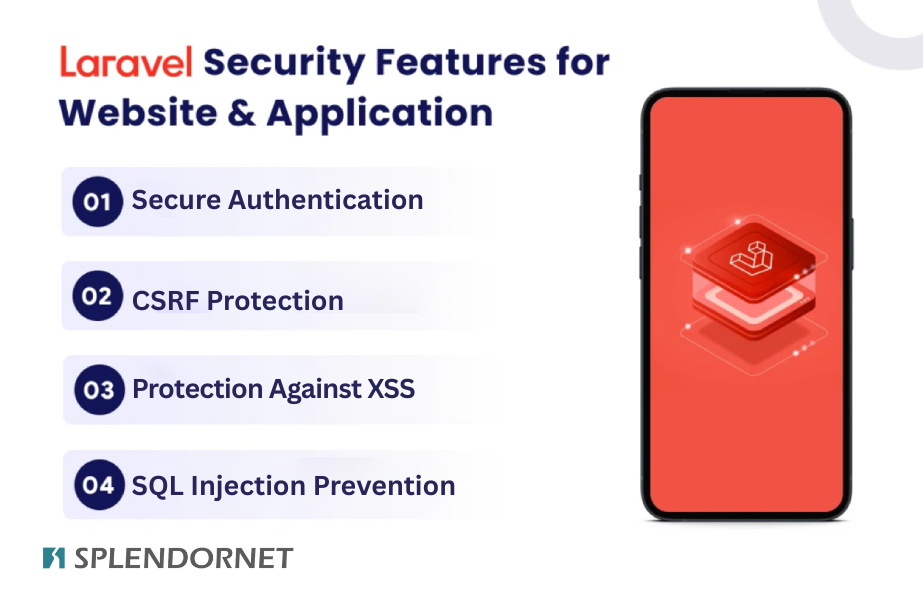
Laravel Security Features

Laravel is a popular development platform, developed in PHP, well-known for its performance and active user community. Laravel is secured platform and he has considered below points.

1. Laravel Authentication System

Laravel hacking is a common problem that can further cause vulnerabilities to other supporting XSS and different files. Most casualties of website hacks find that their site pages are diverted to other malicious websites.

Laravel already has a robust user authentication process in place with the associated boilerplate code available in the scaffolding.

2. Reduce Laravel Vulnerabilities from CSRF (Cross-Site Request Forgery)

Laravel employs CSRF tokens to prevent external third parties from generating fake requests, mitigating potential security vulnerabilities within the Laravel framework.

3. Protection Against XSS (Cross-Site Scripting)

In XSS attacks, attackers inject JavaScript, often into a website’s form text areas. When new visitors access the affected page or form, the injected script executes, causing malicious impacts.

4. SQL Injection

Laravel’s Eloquent ORM uses PDO binding that protects from SQL injections. This feature ensures that no client can modify the intent of the SQL queries.

What’s New in OpenCart v4.0.2.0

OpenCart version 4.0.2.0 is the latest version of the popular open-source E-commerce platform. This new version has been designed with improved performance and enhanced scalability in mind. It also comes with a range of new features. In this article, we will take a look at some of the new or existing fine tunned features in OpenCart:
Note: (Information from official OpenCart Site)

Top 8 OpenCart Features To Scale Up Your Store

If you don’t want to waste OpenCart’s power, let us introduce you to the top 8 OpenCart features that can work magic on your store conversions

1. Product and category management

Here is a list of OpenCart’s product and category management features you might love to try:

2. Marketing

No matter how good your products are, you won’t be able to scale up your store without proper marketing campaigns.
OpenCart gives you five important marketing-related features:

3. Multi-Store

OpenCart lets you manage several stores with just one setup. Once you’ve set up OpenCart for one store, you can add more stores

4. Search engine optimization (SEO)

OpenCart supports using URLs that are optimized for search engines for its product, category, manufacturer, and information pages.

5. Payment gateways

OpenCart natively supports over 50 payment gateways with big names like PayPal, Square, 2Checkout, Amazon Pay, etc

6. Shipping

You can find the shipping method extensions in OpenCart by going to Extensions > Shipping. OpenCart comes with several basic shipping methods

7. Analytics

OpenCart comes with a major reports like Sales, Product, Customer & Marketing reports

8. Themes and modules

With over 13,000 themes and modules on the OpenCart Extension Store, you can easily pick a quality theme and fuel your store growth with a wide range of robust add-ons.

Unleashing the Power of PHP: SplendorNet’s Dominance in Pune’s Web Development Landscape

In the clamoring city of Pune, another time of web advancement is unfurling, with PHP at its center. As organizations look for dynamic and versatile web answers for stay ahead in the advanced race, the interest for capable PHP improvement administrations has flooded. Enter SplendorNet, Pune’s driving PHP improvement organization, changing the web advancement circle with unrivaled skill and development.

Why SplendorNet Hangs Out in Pune's PHP Improvement Scene

Unrivaled Mastery: At SplendorNet, we invest wholeheartedly in our group of prepared PHP engineers who have an abundance of involvement and a profound comprehension of the complexities of PHP web improvement. Our designers are not simply coders; they are pioneers who persistently endeavor to push the limits of what’s conceivable, conveying custom arrangements customized to meet your special business necessities.

Inventive Arrangements, Heavenly Execution: Utilizing the adaptability and force of PHP, we create web applications that are vigorous and versatile as well as easy to use and stylishly satisfying. Whether you’re meaning to construct a powerful online business stage, a substance rich CMS, or a custom web application, SplendorNet has the skill and assets to bring your vision.

Client-Driven Approach: At SplendorNet, client fulfillment is our most extreme need. We have faith in producing solid, enduring associations with our clients by offering straightforward correspondence, opportune venture conveyance, and unmatched post-sending support. Our lithe improvement procedure guarantees a consistent and cooperative improvement experience, keeping you in the know constantly.

SplendorNet: Spearheading PHP Advancement Greatness in Pune

As Pune keeps on advancing as a flourishing tech center, SplendorNet stays at the front line of PHP improvement development, driving groundbreaking arrangements that enable organizations to flourish in the computerized scene. Our broad portfolio is a demonstration of our mastery, including a different scope of fruitful undertakings that have assisted organizations across different enterprises with accomplishing their web-based goals.

Yet, what really separates SplendorNet is our steady obligation to greatness and our tireless quest for advancement. Our fulfilled clients, going from new businesses to Fortune 500 organizations, stand as a demonstration of our commitment and skill, with their examples of overcoming adversity filling in as a definitive approval of our capacities.

In the quick moving universe of web improvement, where advances and patterns are continually developing, SplendorNet stays an unfaltering guide of greatness, driving advancement and setting industry benchmarks. Assuming that you’re looking for a dependable and experienced php development company in pune that lines up with your business objectives and values, look no farther than SplendorNet. We should team up and set out on a groundbreaking excursion towards accomplishing your computerized desires.