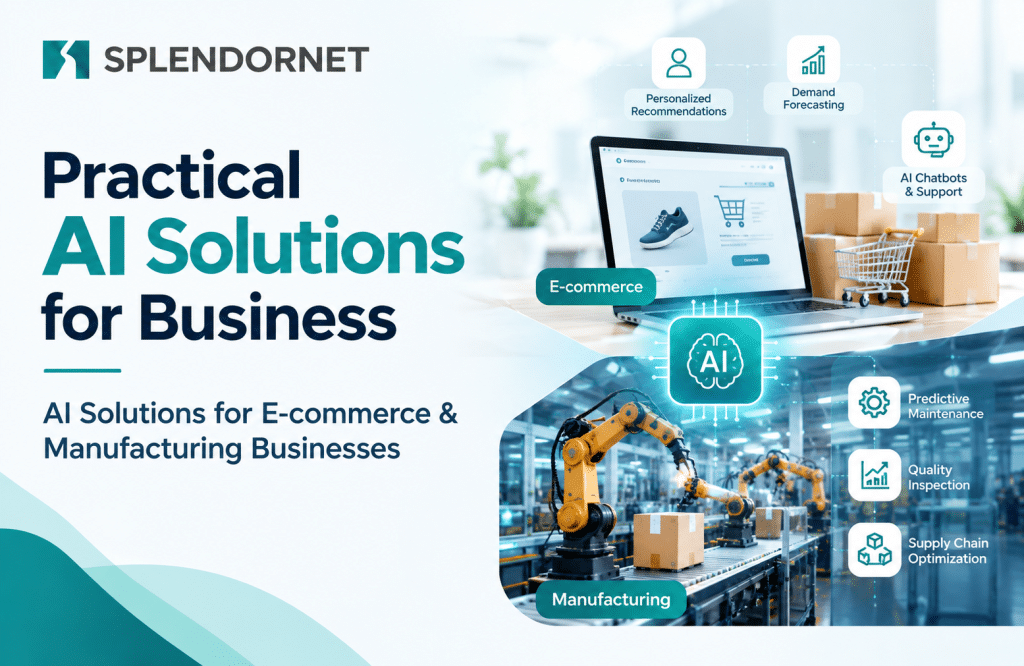
Artificial intelligence is moving beyond chatbots and content generation. Today, businesses are increasingly using AI for business process automation, predictive analytics, demand forecasting, customer insights, and operational optimization.
The biggest opportunity isn’t simply adopting AI because it is trending. The real value comes from identifying specific business problems where AI can improve efficiency, reduce costs, increase revenue, or support better decision-making.
The biggest opportunity isn’t simply adopting AI because it is trending. The real value comes from identifying specific business problems where AI can improve efficiency, reduce costs, increase revenue, or support better decision-making.
Where Can AI Create Real Business Value?
The key question businesses should ask isn’t:
“Should we use AI?”
It’s:
“Where can AI solve a real business problem and deliver measurable value?”
From e-commerce to manufacturing, AI can be integrated into existing workflows and technology systems to address repetitive tasks, improve forecasting, and provide actionable business insights.
“Should we use AI?”
It’s:
“Where can AI solve a real business problem and deliver measurable value?”
From e-commerce to manufacturing, AI can be integrated into existing workflows and technology systems to address repetitive tasks, improve forecasting, and provide actionable business insights.
E-commerce companies generate large amounts of customer, product, sales, and inventory data. AI can turn this data into practical business opportunities.
1. Personalized Product Recommendations
AI-powered recommendation systems can analyze customer behavior, purchase history, browsing activity, and product preferences to suggest relevant products.
This can help businesses:
This can help businesses:
- Increase average order value
- Improve customer engagement
- Increase conversion rates
- Create personalized shopping experiences
2. Demand and Sales Forecasting
AI demand forecasting can analyze historical sales, seasonality, customer behavior, and other business factors to predict future demand.
Better sales forecasting can help businesses plan inventory, purchasing, staffing, and marketing activities more effectively.
Better sales forecasting can help businesses plan inventory, purchasing, staffing, and marketing activities more effectively.
3. AI Customer Service Automation
AI-powered customer service can automate repetitive customer queries and support activities.
Businesses can use AI to:
Businesses can use AI to:
- Answer frequently asked questions
- Classify customer requests
- Provide order information
- Route complex issues to employees
- Support customers 24/7
This allows customer-service teams to focus on higher-value interactions.
4. Customer Behavior Analysis
AI can identify patterns in customer behavior that may be difficult to detect manually.
Businesses can use these insights to understand:
Businesses can use these insights to understand:
- Which customers are likely to purchase
- Which products customers prefer
- Why customers may abandon purchases
- Which customers may be at risk of leaving
- Which marketing campaigns perform best
5. AI-Powered Inventory Optimization
Inventory management is a major challenge for e-commerce businesses.
AI can help analyze demand patterns and inventory levels to support better stock planning, reduce overstocking, and minimize stockouts.
AI can help analyze demand patterns and inventory levels to support better stock planning, reduce overstocking, and minimize stockouts.
Manufacturing businesses can also benefit significantly from practical AI applications. AI can connect operational data with predictive analytics to improve production efficiency and decision-making.
1. Predictive Maintenance
Instead of waiting for equipment to fail, businesses can use AI to identify patterns that indicate potential equipment problems.
Predictive maintenance can help manufacturers:
Predictive maintenance can help manufacturers:
- Reduce unexpected downtime
- Improve equipment utilization
- Plan maintenance more effectively
- Reduce maintenance costs
- Extend equipment life
2. Production and Demand Forecasting
AI can analyze historical production data, sales trends, demand patterns, and other operational factors to support production planning.
More accurate forecasting can help businesses align production capacity with expected demand.
More accurate forecasting can help businesses align production capacity with expected demand.
3. AI-Powered Quality Monitoring
AI and computer vision can assist with quality inspection by identifying defects, inconsistencies, or anomalies during production.
This can improve quality-control processes while reducing the dependency on completely manual inspection.
This can improve quality-control processes while reducing the dependency on completely manual inspection.
4. Manufacturing Inventory Optimization
AI can help manufacturers analyze raw materials, components, finished goods, demand, and supply patterns.
The goal is to maintain appropriate inventory levels while reducing unnecessary holding costs and supply-related disruptions.
The goal is to maintain appropriate inventory levels while reducing unnecessary holding costs and supply-related disruptions.
5. Automated Reporting and Decision Support
Many businesses spend significant time collecting data, preparing reports, and analyzing operational information.
AI can automate parts of this process by bringing together data from existing systems and generating useful insights, summaries, alerts, and decision-support information.
AI can automate parts of this process by bringing together data from existing systems and generating useful insights, summaries, alerts, and decision-support information.
How to Identify the Right AI Opportunity
Before investing in an AI solution, businesses should identify a process where there is a measurable problem.
Ask:
Ask:
- What process is repetitive or time-consuming?
- Where are employees spending significant manual effort?
- Where are decisions based on incomplete or delayed information?
- Where could better forecasting improve business performance?
- Where are errors or inefficiencies affecting costs?
- What business outcome would make the project worthwhile?
The best AI projects are not necessarily the most complicated ones. They are the ones that solve a meaningful problem and produce measurable results.
At SplendorNet, we help businesses identify practical AI opportunities and develop solutions around their existing systems, processes, data, and technology stack.
Whether the goal is business process automation, predictive analytics, demand forecasting, customer behavior analysis, inventory optimization, or AI-powered decision support, we focus on finding solutions that align with real business needs.
You don’t necessarily need a large AI team or a complete technology overhaul to get started.