AI is no longer something companies are experimenting with on the side.
For many businesses, it has become a business priority. But there’s a problem: building AI capabilities in-house requires the right people, technology, time, and investment.
That’s why more companies are turning to AI development partners and outsourcing teams.
So, which industries are using AI outsourcing the most?
Technology & IT
Technology companies are naturally among the biggest AI adopters.
They’re using AI for software development, coding assistance, automation, DevOps, data engineering, and AI-powered applications. Instead of building every capability internally, many companies are working with specialized development partners.
They’re using AI for software development, coding assistance, automation, DevOps, data engineering, and AI-powered applications. Instead of building every capability internally, many companies are working with specialized development partners.
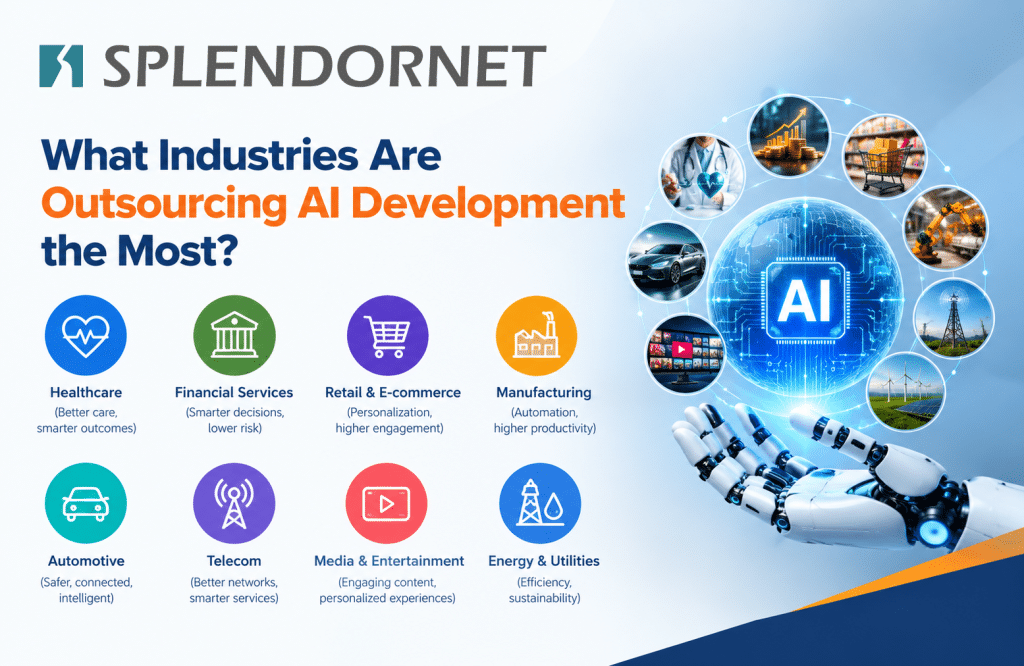
Retailers are using AI to create more personalized customer experiences.
Think:
Product recommendations → Demand forecasting → Customer service → Marketing personalization → Inventory optimization
For many businesses, an external AI partner can help bring these capabilities to market faster.
Think:
Product recommendations → Demand forecasting → Customer service → Marketing personalization → Inventory optimization
For many businesses, an external AI partner can help bring these capabilities to market faster.
Healthcare
Healthcare is another major area where AI outsourcing is growing.
Companies are exploring AI for medical imaging, patient analytics, disease-risk prediction, healthcare platforms, and process automation.
The biggest advantage is access to specialized AI talent without having to build an entire AI team from scratch.
Companies are exploring AI for medical imaging, patient analytics, disease-risk prediction, healthcare platforms, and process automation.
The biggest advantage is access to specialized AI talent without having to build an entire AI team from scratch.
Financial Services & FinTech
Banks and fintech companies are using AI for areas such as:
- Fraud detection
- Credit risk analysis
- Customer analytics
- Robo-advisory
- Banking automation
These projects often require highly specialized AI and compliance expertise, making outsourcing an attractive option when companies don’t want to build large permanent teams.
And it's not only large enterprises
Small and mid-sized businesses are also exploring AI outsourcing because they often don’t have the budget or resources to maintain a large internal AI team.
This is where outsourcing can make a real difference: access to specialized talent without the cost and complexity of building everything internally.
This is where outsourcing can make a real difference: access to specialized talent without the cost and complexity of building everything internally.
The bigger shift
AI outsourcing is moving beyond simply “saving development costs.”
Companies are increasingly outsourcing AI because they need specialized expertise, faster execution, and access to skills that may be difficult to hire internally.
The real question for businesses in 2026 isn’t:
“Should we use AI?”
It’s:
“Which AI capabilities should we build internally, and where should we bring in an experienced partner?”
That decision could have a major impact on how quickly a company can turn AI investment into real business value.